Practical Guide

Solar Panels on a Listed Farmhouse in Tuscany: Solutions, Permits and Incentives

Leopoldo Manini - Founder MANINI® — — 22 min read

Solar Panels on a Listed Farmhouse in Tuscany: Solutions, Permits and Incentives

Introduction

Installing a photovoltaic system on a listed farmhouse in Tuscany is possible, but requires a specific design strategy. Landscape protection doesn't prohibit solar panels: it requires them to be invisible or perfectly integrated. This article analyses the technical solutions, required permits, costs and available incentives.

The challenge is reconciling two legitimate needs: energy efficiency (legally mandatory in major renovations) and protection of the Tuscan landscape. Solutions exist and are increasingly refined.

The Renewable Energy Obligation

Legislative Decree 199/2021 (transposing the RED II Directive) requires that in major first-level renovations (intervention on over 50% of the building envelope) at least 60% of thermal energy demand and a share of electrical energy be covered by renewable sources.

For a 200 sqm farmhouse targeting energy class A2-A3, this translates to:

  • Heat pump for heating/cooling (covers the thermal obligation)
  • Photovoltaic system of 4-8 kWp (covers the electrical obligation)

Landscape Protection and Photovoltaics

Legislative Decree 42/2004 (Cultural Heritage Code) and DPR 31/2017 regulate solar panel installation in protected areas:

Free interventions (no landscape authorisation):

  • Roof-integrated panels (solar tiles) on buildings NOT declared of cultural interest
  • Ground-mounted panels in pertinent areas not visible from public spaces

Simplified landscape authorisation:

  • Panels on flat roofs not visible from below
  • Panels on outbuildings (garages, sheds) not directly listed

Ordinary landscape authorisation:

  • Panels on pitched roofs of listed buildings
  • Panels visible from roads or panoramic viewpoints
  • Ground-mounted systems in visible areas

Prohibited (except exceptional cases):

  • Panels on buildings declared of particularly important cultural interest (art. 10)
  • Installations that significantly alter landscape perception

Tuscany Soprintendenza Guidelines

The Florence Soprintendenza has published specific guidelines:

  • Preference for integrated solutions (solar tiles, solar coppi)
  • Panels permitted only on slopes not visible from public spaces
  • Panel colour consistent with roofing (no blue panels on terracotta)
  • Ground structures permitted only if screened by vegetation
  • Minimum distance from ridge and roof edges

Technical Solutions for Listed Farmhouses

1. Solar Tiles (Most Accepted Solution)

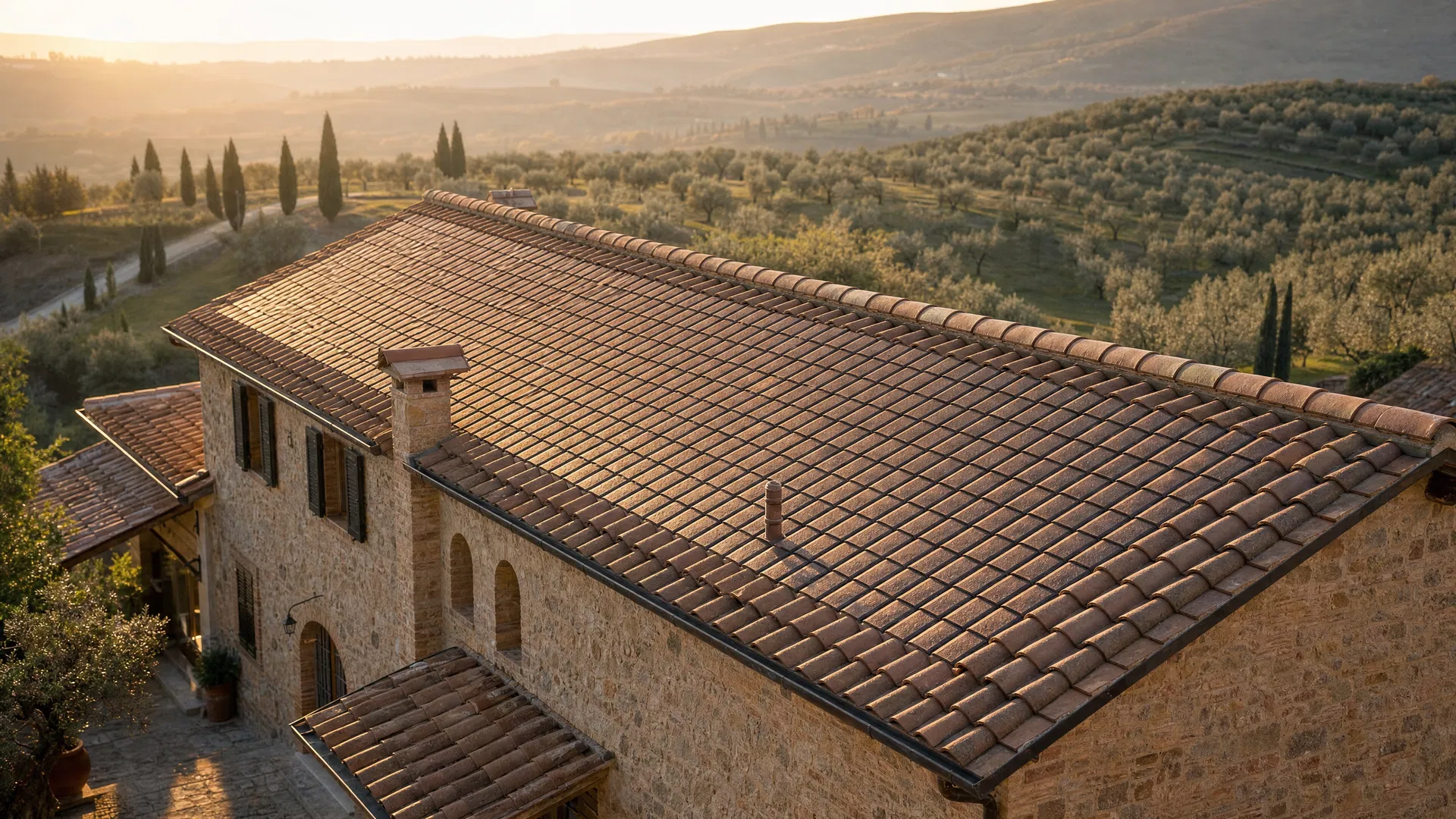
Solar tiles replace traditional tiles integrating invisible solar cells from the outside.

Available products:

  • SunRoof Solar Tile: identical appearance to Tuscan coppo, 18-20% efficiency
  • Dyaqua: recycled material tile with integrated cell
  • Autarq: modular system adaptable to different tile shapes

Performance for 80 sqm south-facing roof slope:

  • Installable power: 4-6 kWp
  • Estimated annual production: 5,000-7,500 kWh
  • Electrical demand coverage: 60-90% (with storage)

Costs:

  • Solar tiles: €400-€600/sqm (vs €80-€120/sqm for normal tiles)
  • For 40 sqm of solar tiles (4 kWp): €16,000-€24,000
  • Inverter and switchgear: €2,000-€4,000
  • 10 kWh storage: €5,000-€8,000
  • Total with storage: €23,000-€36,000

Advantages:

  • Invisible from outside
  • Accepted by Soprintendenza in almost all cases
  • No additional roof structures required
  • Protect the roof like normal tiles

Disadvantages:

  • Cost 3-5 times higher than traditional panels
  • Slightly lower efficiency (18-20% vs 21-23%)
  • More complex maintenance
  • Limited availability for some tile shapes

2. Panels on Non-Visible Roof Slope

If the farmhouse has a south-facing slope not visible from public roads or panoramic viewpoints, traditional panels can be authorised.

Requirements for approval:

  • Slope not visible from public spaces (photographic verification)
  • Panels coplanar with roof slope (no inclined structures)
  • Dark colour (full-black panels, no silver frames)
  • Minimum distance from ridge: 50-80 cm
  • Distance from lateral edges: 30-50 cm

Costs for 6 kWp on existing roof:

  • Full-black panels (15-18 panels): €4,000-€6,000
  • Coplanar structure: €1,500-€2,500
  • Hybrid inverter: €2,000-€3,500
  • 10 kWh storage: €5,000-€8,000
  • Installation: €2,000-€3,000
  • Total with storage: €14,500-€23,000

3. Ground-Mounted System in Pertinent Area

For farmhouses with land, ground-mounted systems are often the best solution: they don't touch the roof and can be screened by vegetation.

Requirements for approval:

  • Area not visible from public roads
  • Screening with hedges or native vegetation
  • Minimum distance from boundaries: 3-5 m
  • Maximum structure height: 2-2.5 m
  • Contained occupied surface

Costs for 8 kWp ground-mounted:

  • Panels (20 panels): €5,000-€7,000
  • Ground structure (aluminium/steel): €3,000-€5,000
  • Excavation and foundations: €2,000-€4,000
  • Underground cable duct to farmhouse: €1,500-€3,000
  • Inverter and storage: €7,000-€11,000
  • Vegetation screening: €1,000-€2,500
  • Total with storage: €19,500-€32,500

Advantages:

  • Doesn't modify the roof
  • Optimal orientation and inclination
  • Easy maintenance and cleaning
  • Expandable in future

Disadvantages:

  • Occupies land
  • Requires underground cable duct
  • Needs vegetation screening
  • Vegetation growth time

4. Solar Carport

A car shelter with photovoltaic roofing is often accepted as a pertinent structure.

Costs for 2-car carport (25 sqm, 5 kWp):

  • Timber/corten steel structure: €8,000-€15,000
  • Integrated panels: €3,000-€5,000
  • Inverter and storage: €7,000-€11,000
  • Total: €18,000-€31,000

Storage and Self-Consumption: The Economic Key

For a farmhouse in Tuscany, self-consumption is fundamental for system profitability:

Without storage:

  • Direct self-consumption: 30-40%
  • Surplus fed to grid: €0.08-€0.10/kWh (Net Metering)
  • Annual savings: €800-€1,200

With 10 kWh storage:

  • Total self-consumption: 70-85%
  • Annual savings: €1,500-€2,200
  • Storage payback: 5-7 years

With storage + heat pump:

  • Total self-consumption: 60-75% (including heating)
  • Annual savings: €2,500-€4,000
  • Near-total elimination of gas bill

Tax Incentives 2026

| Incentive | Deduction | Duration | Requirements |

|-----------|-----------|----------|-------------|

| Renovation Bonus | 50% | 10 years | System on residential building |

| Ecobonus | 65% | 10 years | If combined with efficiency intervention |

| Residual Superbonus | 65% | 10 years | If driven by insulation or boiler |

| Conto Termico | Direct contribution | Immediate | Alternative to tax bonuses |

| Reduced VAT | 10% | Immediate | On residential systems |

For a €25,000 system with 50% Renovation Bonus: €12,500 deduction over 10 years (€1,250/year).

Authorisation Process: Timelines

| Installation type | Permit | Timeline |

|------------------|--------|----------|

| Solar tiles (non art. 10) | Municipal notification | 15-30 days |

| Panels on non-visible slope | Simplified landscape auth. | 60-90 days |

| Panels on visible slope | Ordinary landscape auth. | 120-180 days |

| Screened ground system | Simplified landscape auth. | 60-90 days |

| Visible ground system | Ordinary landscape auth. | 120-180 days |

Mistakes to Avoid

1. Installing without authorisation

In a protected area, an unauthorised system is a building offence. Penalty: demolition + €10,000-€50,000 fine + criminal prosecution.

2. Choosing standard blue panels

Blue panels with silver frames are the main reason for application rejection. Always use full-black panels or integrated tiles.

3. Not considering shading

Cypresses, oaks and other trees typical of the Tuscan landscape can shade the roof for hours. A shading analysis is essential before design.

4. Undersizing the system

With a heat pump, the electrical demand of a 200 sqm farmhouse is 8,000-12,000 kWh/year. A 3 kWp system (producing ~3,750 kWh) is insufficient.

5. Not planning EV charging provision

The future is electric. Including an EV charging point (wallbox) during installation costs €500-€1,000 extra. Adding it later costs €2,000-€3,000.

Case Study: Listed Farmhouse in Val d'Orcia

Situation: 220 sqm farmhouse, UNESCO landscape protection, 4-slope terracotta roof, heat pump installed, electrical demand 10,000 kWh/year.

Solution adopted:

  • Solar tiles on south slope (not visible from road): 5 kWp
  • Ground system in rear garden (screened by laurel hedge): 4 kWp
  • Storage: 15 kWh
  • Total: 9 kWp

Results:

  • Annual production: 11,250 kWh
  • Self-consumption with storage: 78%
  • Annual savings: €3,200
  • Total cost: €52,000
  • 50% deduction: €26,000 over 10 years
  • Net cost: €26,000
  • Net payback: 8 years

Conclusion

Photovoltaics on a listed farmhouse is not an insurmountable obstacle: it's a design challenge requiring specific solutions. Integrated tiles, panels on non-visible slopes and screened ground systems are all viable options. The key is designing the system together with the renovation, not as a later addition.

Want to install photovoltaics on your listed farmhouse? Our team can analyse available options and manage the entire authorisation process with the Soprintendenza.

Frequently Asked Questions

Can you install solar panels on a listed farmhouse?

Yes, with specific solutions: solar tiles (invisible from outside), full-black panels on slopes not visible from public spaces, or ground systems screened by vegetation. Landscape authorisation required (60-180 days).

How much does solar cost on a listed farmhouse?

Depends on solution: panels on non-visible slope with storage €14,500-€23,000, screened ground system €19,500-€32,500, solar tiles €23,000-€36,000. With 50% Bonus you recover half over 10 years.

Are solar tiles accepted by the Soprintendenza?

Yes, in almost all cases. Solar tiles are the most accepted solution because they're invisible from outside and compatible with the traditional terracotta roof appearance. They cost €400-€600/sqm but don't require ordinary landscape authorisation.

How much does a solar system produce in Tuscany?

In Tuscany, 1 kWp produces approximately 1,250 kWh/year. A 6 kWp system produces ~7,500 kWh/year, sufficient to cover 60-75% of a 200 sqm farmhouse's demand with heat pump (with 10 kWh storage).

Related Articles