Permits & Regulations

Renovation Permits in Italy: SCIA, CILA and Permesso di Costruire Explained

Leopoldo Manini - Founder MANINI® — — 16 min read

Renovation Permits in Italy: SCIA, CILA and Permesso di Costruire Explained

Introduction

The Italian building permit system is one of the aspects that most confuses foreign buyers. Three acronyms — SCIA, CILA and Permesso di Costruire — cover almost all interventions, but understanding which one your project needs requires specific knowledge of the regulations.

This article clearly explains when each permit is needed, how long it takes, how much it costs and what the consequences of getting it wrong are. If you want a complete overview of costs, also read our guide to renovation costs.

Works that require no permit

Some interventions fall under "edilizia libera" (free building) and require no communication to the Municipality:

  • Internal and external painting (if not in a restricted area)
  • Floor replacement without structural modifications
  • Replacement of sanitary ware and taps
  • Ordinary maintenance of existing systems
  • Installation of solar panels on flat roofs (within certain limits)
  • Replacement of internal doors
  • Non-structural false ceiling works

Warning: if the property is subject to landscape or historical-artistic restrictions, even these interventions may require Soprintendenza authorisation. In Tuscany, most rural farmhouses fall within restricted areas.

CILA — Certified Start of Works Communication

CILA is the lightest permit. It's used for extraordinary maintenance that doesn't affect the load-bearing structure of the building.

Typical examples:

  • Demolition and reconstruction of internal partitions (non-load-bearing walls)
  • Complete bathroom and kitchen renovation
  • New internal space distribution
  • Complete rewiring and replumbing
  • False ceilings and internal insulation
  • Opening or closing doors in non-load-bearing walls

Procedure: the technician (architect or geometra) submits the CILA to the Municipality with a certified report. Works can begin immediately after submission, without waiting for a response.

Cost: secretarial fees from €200 to €500 depending on the Municipality, plus technician's fee (€1,500-€3,000 for the complete practice).

Validity: CILA has no expiry, but works must be completed within a reasonable timeframe (generally 3 years).

Penalty for works without CILA: €1,000 (fixed penalty), plus possible restoration order if works are non-compliant.

SCIA — Certified Activity Start Notification

SCIA is the intermediate permit. It's used for extraordinary maintenance affecting the load-bearing structure or for restoration and conservative renovation.

Typical examples:

  • Opening or closing doors/windows in load-bearing walls
  • Structural consolidation (floors, roof, foundations)
  • Roof replacement with structural modifications
  • Construction of structural mezzanines
  • Splitting or merging property units
  • Change of use without volume increase

Procedure: the technician submits the SCIA to the Municipality with a certified report, drawings and, if necessary, a structural project filed with the Genio Civile. Works can begin from the submission date.

Cost: secretarial fees €300-€800, plus technician's fee €3,000-€8,000 depending on complexity. If a structural project is needed, add €5,000-€15,000 for the structural engineer.

Validity: 3 years from submission. If works don't begin within 1 year, the SCIA lapses.

Penalty for works without SCIA: pecuniary penalty equal to double the property's value increase, with a minimum of €516. In cases of serious abuse, possible demolition order.

Permesso di Costruire (Building Permit)

The Permesso di Costruire is the heaviest authorisation. It's required for new construction, major renovation and extensions.

Typical examples:

  • Demolition and reconstruction (even with different footprint)
  • Volume extension
  • Change of use with structural works
  • New construction (guest house, garage, covered pool)
  • Renovation with increase in property units and significant structural modifications

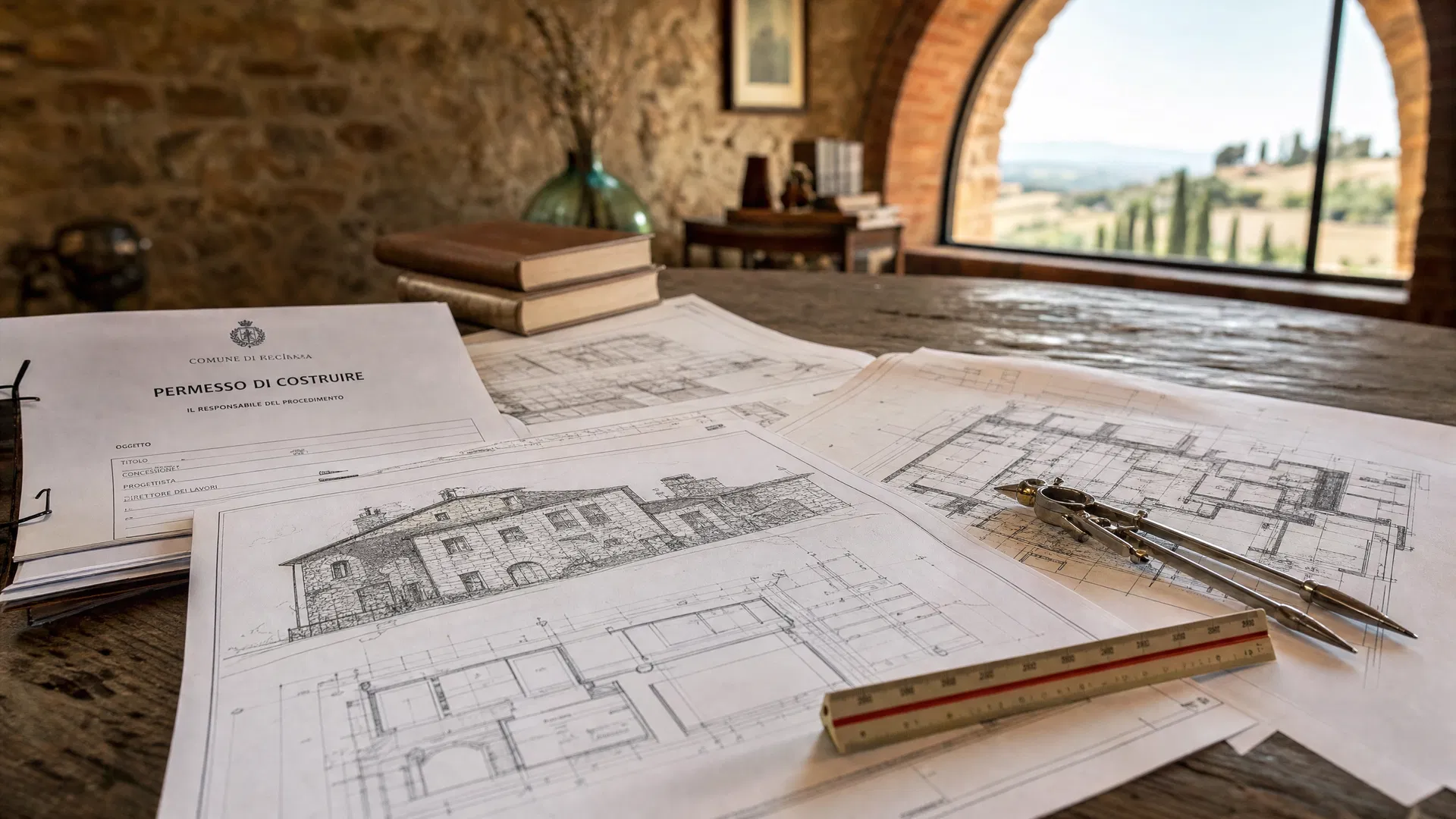
Procedure: the technician submits the application to the Municipality with a complete project. The Municipality has 60 days to respond (90 days in restricted areas). Silent consent applies only in some cases.

Cost: secretarial fees €500-€1,500, urbanisation charges (variable, from €50 to €200/sqm), construction cost contribution (4-12% of intervention cost), plus technician's fee €5,000-€15,000.

Validity: 3 years from issue. Works must begin within 1 year and be completed within 3 years.

Penalty for works without permit: pecuniary penalty up to €20,658 or demolition of the illegal work. In cases of illegal subdivision, also criminal consequences.

Landscape restriction: the permit within the permit

In Tuscany, most rural territory is subject to landscape restriction (D.Lgs. 42/2004). This means that, in addition to the building permit, you also need landscape authorisation issued by the Soprintendenza.

Additional timelines: 45-90 days for simplified landscape authorisation, 90-180 days for ordinary. In practice, with the Soprintendenza, timelines double.

What it means: the project must respect aesthetic and material criteria consistent with the context. No visible external insulation, no PVC windows, no non-traditional colours, no solar panels visible from the road.

Practical advice: before buying a property in a restricted area, check with the Municipality which interventions are permissible. Some owners discover too late that their desired project cannot be authorised.

Seismic restriction: filing with the Genio Civile

If the property is in seismic zone 1, 2 or 3 (almost all of Tuscany is in zone 2 or 3), every structural intervention requires filing the project with the Genio Civile before works begin.

Procedure: the structural engineer prepares the project with seismic calculations and files it. In zone 2, seismic authorisation is also required (filing alone is not sufficient).

Timelines: filing with silent consent in 30 days (zone 3), authorisation in 60-120 days (zone 2).

Additional cost: €5,000-€15,000 for the structural project, depending on complexity.

Summary table

  • Edilizia libera: no permit, immediate start, zero cost
  • CILA: light extraordinary maintenance, immediate start, €200-500 + technician
  • SCIA: heavy extraordinary maintenance/restoration, immediate start, €300-800 + technician + possible structural engineer
  • Permesso di Costruire: major renovation/new construction, 60-90 day wait, €500-1,500 + charges + technician

Common mistakes to avoid

Starting works without a permit: even if "they're just internal works", the lack of CILA or SCIA carries penalties and, more importantly, problems at the time of sale. A property with unresolved building violations is unsellable or sellable only at a significant discount.

Confusing CILA and SCIA: if you submit a CILA for works requiring SCIA, the Municipality can halt the site and require regularisation. Time lost and additional costs.

Not checking planning compliance before purchase: if the property has pre-existing violations (unauthorised extensions, unregistered changes of use), responsibility falls on the buyer. This is one of the key points of pre-purchase due diligence.

Underestimating Soprintendenza timelines: in restricted areas, scheduling work to begin without having obtained landscape authorisation is a mistake that costs months of delay.

How to choose the right technician

The technician who submits permits (architect, engineer or geometra) is a key figure. They must know:

  • The specific Municipality's planning regulations
  • The local Soprintendenza's practices
  • Real timelines (not theoretical ones) for applications
  • Possibilities for regularising any pre-existing discrepancies

A local technician with experience in the specific Municipality is worth far more than a prestigious professional who doesn't know the territory. For those managing the project from abroad, having a project manager who also coordinates bureaucratic aspects is essential.

The MANINI method for permits

MANINI EXTRA manages the entire authorisation process as part of the project management service. The client doesn't need to worry about understanding which permit is needed, which documents to produce or how to interface with the Municipality and Soprintendenza.

Our technical team:

  • Verifies planning and cadastral compliance before purchase
  • Identifies the correct authorisation for the planned intervention
  • Prepares and submits all documentation
  • Manages relationships with Municipality, Soprintendenza and Genio Civile
  • Monitors timelines and anticipates potential issues

Have a property to renovate and don't know which permits you need? Request a consultation with our technical team for a free preliminary assessment.

Frequently Asked Questions

What is the difference between CILA and SCIA in Italy?

CILA is for extraordinary maintenance not affecting the load-bearing structure (partitions, systems, internal layout). SCIA is needed when intervening on the structure (load-bearing walls, floors, roof) or for conservative restoration.

How long does it take to get a Permesso di Costruire?

The Municipality has 60 days to respond (90 in restricted areas). Add landscape authorisation (45-180 days) and Genio Civile filing (30-120 days) if required.

What happens if I do works without a permit in Italy?

Penalties vary: €1,000 for works without CILA, up to €20,658 or demolition for works without Permesso di Costruire. Additionally, a property with building violations is difficult to sell.

Do I need landscape authorisation in Tuscany?

In most rural Tuscan territory, yes. The landscape restriction requires additional Soprintendenza authorisation adding 45-180 days and imposing constraints on materials and colours.

Related Articles